

[For the audio version of this article refer here.]
“She [the United States] has seen that probably for centuries to come, contests of inveterate power, and emerging right [will persist]…But she goes not abroad, in search of monsters to destroy…She well knows that by once enlisting under other banners than her own…she would involve herself beyond the power of extrication, in all the wars of interest and intrigue, of individual avarice, envy, and ambition, which assume the colors and usurp the standard of freedom. The fundamental maxims of her policy would insensibly change from liberty to force… She might become the dictatress of the world. She would be no longer the ruler of her own spirit…”
– speech in 1821 by John Quincy Adams, sixth President of the United States (1825-1829), and the first American Ambassador to Russia in 1809.
This series will discuss how American foreign policy and ideology came to be what Eisenhower would refer to in his farewell address on January 17th, 1961 as the “military-industrial complex” that held whether sought or unsought, the power to acquire unwarranted influence, and that such a “power exists, and will persist,” leaving the following generations of Americans “a legacy of ashes,” for a once great nation.
This series will explain how in particular, the philosophy of the American establishment, including that of the military, formed their “understanding” of nuclear strategy which continues to influence thought today such as in the belief in the winnability of a limited nuclear war. It will also explain the reasons for why the Vietnam war was fought with the approach used as well as the War on Terror, and most importantly why.
A Foreign Attack on American Soil
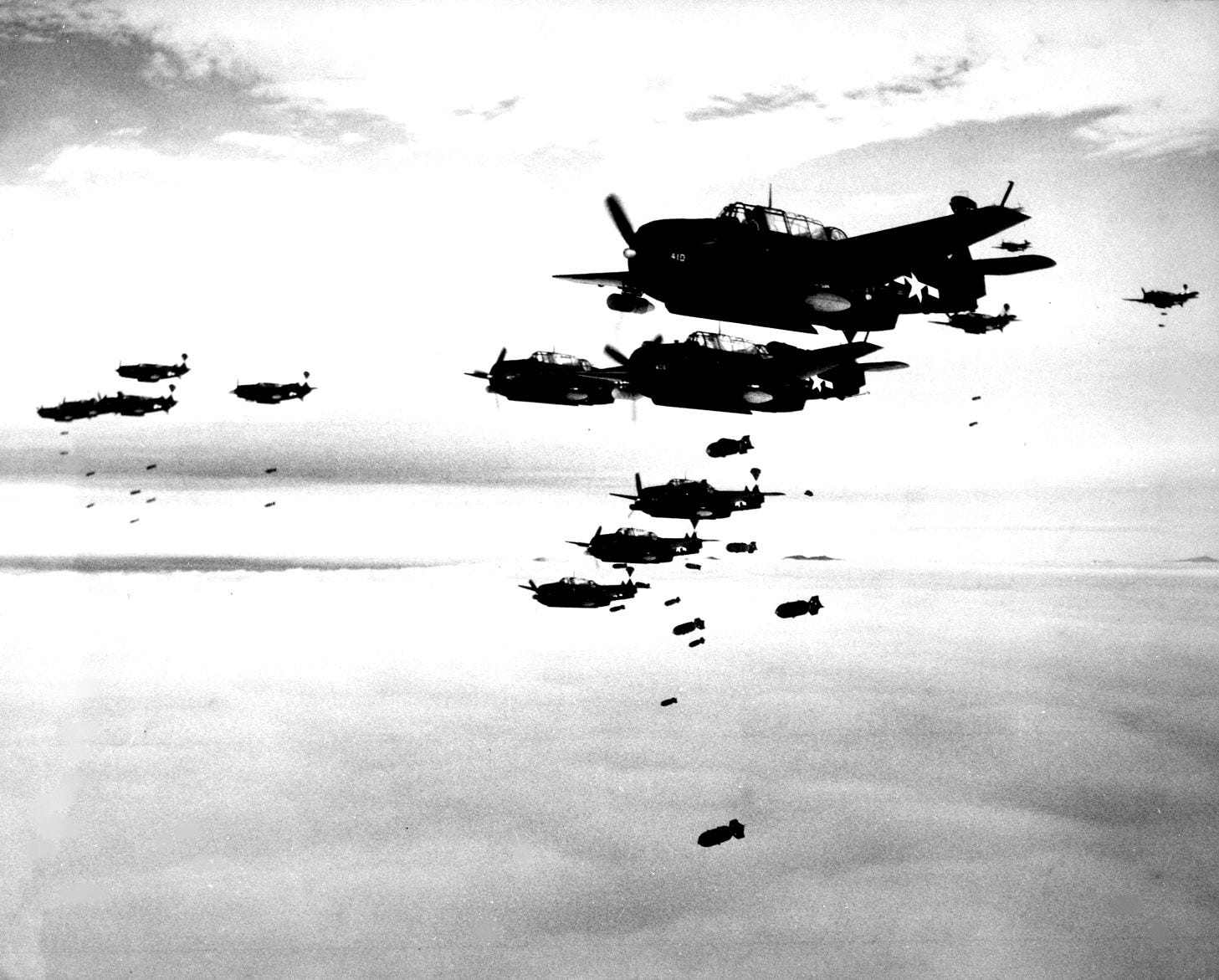
On December 7th, 1941, the United States naval base at Pearl Harbor, Hawaii was attacked by the Japanese navy, killing 2,403 Americans and wounding 1,178. However, the Americans would only begin their military air campaign against Japan by mid-1944.
General MacArthur estimated that a million Americans would die in only the first phase of the Pacific War. The Russians were being heavily courted by the Americans to break their Neutrality Pact with Japan and enter into the Pacific War for the very straightforward reason that fewer Americans would die.
After three years of the most savage warfare against the German Nazis, where over 25 million Russian soldiers and civilians died, Russia was now prepared to enter into another war with Japan, only months later, to offer military support to the U.S., a country that had suffered minute losses in comparison.
When Admiral King, chief of naval operations, was informed that the Russians would definitely enter the fight against Japan, he was immensely relieved commenting “We’ve just saved two million Americans.”
* * *
On April 12th, 1945 President Roosevelt passed away and much of the American-Russian partnership with him.
On July 16th, 1945, the first successful atomic bomb was tested in Alamogordo, New Mexico. Seven days later, Stalin was informed at the Potsdam conference by Truman that America now had the bomb.
Truman, contrary to what he was advised to do, made no mention of collaboration, no mention of making the world peaceful and safe, and no offer to share information with the Russians, not even in return for any quid pro quo. Simply that America now had the bomb.
On August 6th, 1945, Little Boy, the first atomic bomb was dropped on Hiroshima.
On August 9th at 1:00 am, one million Soviet troops crossed the border into eastern Manchuria to face the Kwantung, the culmination of ten months of coordinated planning. Later that same day a second atomic bomb, Fat Man (named after Churchill), was dropped on Nagasaki.
The Russians were completely taken aback. They had not been notified of this plan, and it was certainly not a “friendly” message that the U.S. was sending to their supposed allies.
On August 15th, six days later, Japan surrendered. Many historians have agreed that the Russian attack in Manchuria had the greater weight in causing the Japanese to surrender. (1) But it did not matter.
Most in the West would either never know or would soon forget about the Russian sacrifice.
The decision to drop the bomb, Truman would write in a letter to his daughter Margaret, was “no great decision…not any decision you would have to worry about.”
Nuclear physicist Yuli Khariton would voice a common Russian reaction when he wrote that the two bombs that were dropped on Japan were used “as atomic blackmail against the USSR, as a threat to unleash a new, even more terrible and devastating war,” if Russia refused to play by the rules decided for her.
By the end of WWII, the contrast between the United States and Soviet Union were enormous. The U.S. was supplying over half of the world’s manufacturing capacity, more than half of the world’s electricity, holding two-thirds of the world’s gold stocks and half of all the monetary reserves. It had suffered 405,000 casualties, 0.29 percent of its population (The size of the American population in 1945 was approximately 140 million).
Russia suffered 27 million casualties, 16 percent of its population. The Germans burned 70,000 Russian villages to the ground and destroyed 100,000 farms. Twenty-five million Russians were homeless. 32,000 factories and 65,000 railroad tracks were destroyed. And its major cities: Leningrad, Stalingrad and Moscow were in shambles.
The Godfather of RAND: Air Force General Curtis LeMay
“If we had lost the war, we’d all have been prosecuted as war criminals.”
– Air Force General Curtis LeMay in “The Fog of War”
On October 1st, 1945, less than two months after the dropping of two nuclear bombs on Japan, Commanding General Henry Arnold of the U.S. Army Air Forces, inspired by what the scientists under the Manhattan Project could do, met with Franklin R. Collbohm, Arthur E. Raymond, Donald Douglas, and Edward Bowles. This was the pioneering team that would create RAND.
Franklin R. Collbohm was the right-hand man of Donald Douglas, head of Douglas Aircraft, America’s largest airplane manufacturer, and the special assistant to Arthur E. Raymond, the company’s vice president and head of engineering. Edward Bowles, a consultant from MIT, worked with Collbohm on the notorious B-29 Special Bombardment Project against Japan in 1944.
After witnessing the atomic bomb, Arnold foresaw that the future in warfare would revolve around the technology of long-distance missiles and was adamant that only the Air Force and no other branch of armed forces should control the new weapon. Arnold pledged $10 million from unspent wartime research money to set up the research group and keep it running independently for a few years. (2) Collbohm nominated himself to head the group, which he did for the next 20 years.
Air Force Deputy Chief Curtis LeMay of Air Staff for Research and Development, was soon after brought in by General Arnold and tasked with supervising the new research group.
LeMay, whom it is said Kubrick based his military brass off of in “Dr. Strangelove,” was known for many military “feats” but the most notorious of these was when Arnold sent LeMay to the Mariana, to head the 21st Bomber Command that would execute the inhumane raids over Japanese cities in 1945.
It was there that LeMay first worked with Collbohm, Raymond and Bowles. It was because of Collbohm’s team that the B-29 bombers were able to inflict maximum damage. These incendiary bombs were dropped on the civilian population of Japan, burning alive hundreds of thousands of people. Homes, shops, and buildings of no apparent military value were consumed by the fiery rain that fell from the low-flying B-29s night after night.
This was the same tactic that had been used in Dresden by the European Allies, killing 25,000 civilians (3) but it had never before been used by the Americans who had up until this point avoided civilian populations.
As would occur during the Korean and Vietnam wars, the concept of the enemy was beginning to become blurred for the Americans. They were finding it harder and harder to combat a clearly defined opponent, rather, the “enemy” was increasingly looking like the vague unfamiliarity of an entire people, a whole population of seemingly soulless faces not like their own.
Unlike all the other countries involved in the world war, the Pearl Harbour attack was the first direct foreign offense against the United States other than the war of 1812. It did not matter how much more damage or destruction the Americans would inflict upon the Japanese in response to this, for it was justified as self-defence. An attempt to ensure that such an attack would never dare be repeated against the United States. It was an outlook that would continue on into the war arenas of Korea and Vietnam.
Because of the Pearl Harbor attack, many in the United States began to see large swaths of the world population like a swarming mountain of flesh-eating ants, wishing nothing more than to destroy American values and liberty. It was thought by many that the only way to save oneself and loved ones was to scourge the earth of them.
As General Arnold wrote, “We must not get soft. War must be destructive and to a certain extent inhuman and ruthless.” (4)
Alex Abella writes in his “Soldiers of Reason”:
“…the carpet bombing of Japan left the founding fathers of RAND and the future secretary of defense Robert McNamara, who also collaborated on the B-29 project – with the reputation of looking only to the practical aspect of a problem without concern for morality. Their numbers-driven perspective had the effect, intentional or not, of divorcing ethical questions from the job at hand. Eventually RAND doctrine would come to view scientists and researchers as facilitators, not independent judges. As LeMay himself said, ‘All war is immoral. If you let that bother you, you’re not a good soldier.’”
On March 1st, 1946, RAND had an official charter:
“Project RAND is a continuing program of scientific study and research on the broad subject of air warfare with the object of recommending to the Air Force preferred methods, techniques and instrumentalities for this purpose.” (5)
Unlike other government contractors, RAND would be exempt from reporting to a contracting command. Instead, the unfiltered results would be delivered straight to LeMay. (6)
Within a few years, a new mind-set would take hold in government: science, rather than diplomacy, could provide the answers needed to cope with threats to national security.
Rather than nationalize key military industries, as the UK and France had done, the U.S. government opted to contract out scientific research development to the private sector, which was not bounded by the Pentagon. RAND would be a bridge between the two worlds of military planning and civilian development.
And in a very real way, this great country with an island philosophy went into a fit of madness over the realisation that they were not invulnerable to an outside attack. This realisation, though they were to suffer minor losses compared to that in Europe and Asia during the two world wars, turned into a gaping wound of constant “what ifs,” a never-ending barrage of paranoid suppositions.
From then on, the United States would become obsessed with thwarting the next enemy attack, which they were certain was always in the works.
In Search of a Prophet: Enter the RAND Mathematicians
By March 1st, 1946 there were but four full-time RAND employees. Collbohm’s fifth hire to RAND was John Davis Williams who was to serve as director of the newly created Mathematics Division and would become Collbohm’s right-hand man. (7)
In 1947, Ed Paxson, a RAND engineer created the term “systems analysis” when Williams placed him in charge of the Evaluation of Military Worth Section. Paxson had been a scientific adviser to the U.S. Army Air Forces and a consultant to the U.S. Strategic Bombing Survey in 1945-46.
During WWII, the considered shortcomings of operational research (OR) was that it could not function without hard data, what was already known about a system.
As Alex Abella puts it in his “Soldiers of Reason”:
“RAND’s systems analysis…refused to be constrained by existing reality…Systems analysis was the freedom to dream and to dream big, to turn away from the idea that reality is a limited set of choices, to strive to bend to the world to one’s will…the crux of systems analysis lies in a careful examination of the assumptions that gird the so-called right question, for the moment of greatest danger in a project is when unexamined criteria define the answers we want to extract. Sadly, most RAND analysts failed to perceive this inherent flaw in their wondrous construct. Not only that, the methodology of systems analysis required that all the aspects of a particular problem be broken down into quantities…Those things that could not be eased into a mathematical formula…were left out of the analysis… By extension, if a subject could not be measured, ranged, and classified, it was of little consequence in systems analysis, for it was not rational. Numbers were all – the human factor was a mere adjunct to the empirical.”
On August 29, 1949, the first Soviet nuclear test RDS-1 was conducted, with the yield of 22 kilotons.
With this advent, there was mounting concern over what were the intentions of the Soviet bloc. Did they create their own atomic bomb as simply a defensive manoeuvre or was there the possibility they were planning an offensive?
In response to these questions, RAND put forward the doctrine of “rational choice theory,” developed by a 29 year old economist named Kenneth Arrow. The bulk of Arrow’s work at RAND is still classified top secret to this day. (8)
Arrow was tasked with establishing a collective “utility function” for the Soviet Union. In other words, “rational choice theory” meant to establish mathematically a fixed set of preferences in order to determine what were the best actions that would yield the greatest service to the Soviet leadership’s collective interests.
Since there was a lack of hard evidence, western policy makers became increasingly reliant on mathematical and also psychoanalytical speculation in order to create hypothetical scenarios, such that counter-strategies could be formed. RAND needed Arrow’s “utility function” so its analysts could simulate the actions of the Soviets during a nuclear conflict in order to justify increased funding and military buildup.
As long as somewhat complex mathematical explanations could be used to create such speculations, it was considered under the domain of “science,” and there was no need to cross-check the validity or accuracy of such speculations.
Arrow’s paradox, otherwise known as Arrow’s impossibility theorem, had demonstrated through a mathematical argument that collective rational group decisions are logically impossible.
Abella writes:
“Arrow utilized his findings to concoct a value system based on economics that destroyed the Marxist notion of a collective will. To achieve this result, Arrow borrowed freely from elements of positivist philosophy, such as its concern for axiomization, universally objective scientific truth and the belief that social processes can be reduced to interactions between individuals.” (9)
Arrow’s impossibility theorem lay a theoretical foundation for universal scientific objectivity, individualism and “rational choice.” That the so called “science,” in the form of a mathematical argument, has determined the collective is nothing, the individual is all.
And if we are all just reduced to our petty individual selfish self-interests, who is to challenge the players of the game who wish to shape the world stage?
As Abella phrased it, “Put in everyday terms, RAND’s rational choice theory is the Matrix code of the West.”
In 1950, William’s fascination with game theory peaked after the success of Arrow’s rational choice theory for RAND, and he hired John von Neumann, the father of game theory as a full-time staffer for RAND. Like Williams, von Neumann was an advocate of an all-out pre-emptive nuclear war on the Soviet Union. (10)
Together with Oskar Morgenstern, Neumann cowrote the book that lay the foundation for the field, “Theory Games and Economic Behavior,” published in 1944. Morgenstern and Neumann assumed that players in every game are rational (motivated by selfish self-interests) and that any given situation has a rational outcome. It was Neumann who coined the term “zero-sum game,” referring to a set of circumstances in which a player stands to gain only if his opponent loses.
By the mid-1950s, RAND became the world center for game theory.
Years later RANDites would ruefully acknowledge the futility of attempting to reduce human behavior to numbers. Yet, that has not deterred its continued use in military strategy as well as in numerous fields in academia to this day.
Out of the “science” of systems analysis, governed by a rational choice outlook, a plan to strike pre-emptively at the Soviet Union was born in the halls of RAND.
First Strike: The Revenge of the Technocrats
“Now I have become death, the destroyer of worlds.”
– Bhagavad Gita
In seeking out further independence from its exclusive client the Air Force, RAND under the direction of Collbohm, would be reborn as a non-profit corporation.
H. Rowan Gaither, the attorney who was drafting the RAND articles of incorporation, contacted the Ford Foundation about funding RAND. Gaither obtained not only close to half a million dollars from the Ford Foundation for RAND but he also became Ford Foundation’s president from 1953 to 1956. (11)
It was a steamy love affair in the midst of a Cold War. Ford Foundation was the largest philanthropic organization of the time and was in the process of reorganizing itself to lend financial support for world peace and the advancement of scientific knowledge. What better benefactor than RAND for such noble endeavours?
In a statement Gaither crafted after assuming the presidency of the Ford Foundation, he stated as his goal a society where technocrats ruled using objective analysis, stating:
“This very non-partisanship and objectivity gives the [Ford] foundation a great positive force, and enables it to play a unique and effective role in the difficult and sometimes controversial task of helping to realize democracy’s goals.” (12)
By 1950 administration policy had changed from the theory of containment advocated by George F. Kennan to open military competition. A notable RAND associate, Paul Nitze brought about that change almost single-handedly.
On January 1st, 1950, Paul Nitze replaced Kennan as head of the president’s Policy Planning Staff and wrote a memorandum for the NSC on how to conduct foreign policy in the nuclear age. The paper called NSC-68 warned apocalyptically about the “Kremlin’s design for world domination.”
NSC-68 declared that the U.S. was in the moral equivalent of war with the Soviet Union and called for a massive military buildup to be completed by 1954 dubbed the “year of maximum danger,” the year JIC-502 (drafted January 20th, 1950) claimed the Soviets would achieve military superiority and be able to launch war against the United States.
President Truman accepted NSC 68 as the official policy and increased the national defense budget by almost $40 billion.
It is now known that such a prediction of the Soviet threat was indeed baseless, yet nonetheless, managed to create a deranged positive feedback loop in the ceaseless striving for the largest and most sophisticated nuclear arsenal. It entered the United States into the maniacal mindset that one must always have the greater firing power in order to have the greatest number of options in a nuclear scenario.
This was considered the only option, and not only put the Soviet Union in a difficult position, but the rest of the world as well, for who could withstand such a mighty force if it wished to inflict its will, let alone its paranoia, on any nation?
It is no wonder that the Soviet publication Pravda at this time (late 1950s) famously called RAND “the academy of science and death.” (13)
The Father of all technocrats at RAND, was Albert Wohlstetter.
Albert would be recruited into the dysfunctional RAND family in 1951 by Charles J. Hitch, the head of the RAND economics department. Within a very short period of time Albert would rise to the very top of the RAND food chain.
In achieving this king of the unruly jungle status, he first had to battle with RAND colleague Bernard Brodie. Brodie was an advocate of nuclear deterrence, he was the true developer of the “second-strike capability” doctrine as the ultimate agent of deterrence and the key to global stability in the thermonuclear age.
The only alternative to such mutually assured destruction, Brodie argued, was a fundamental shift in humanity’s understanding of warfare.
This thought had established Brodie in 1951 as a major strategist of nuclear war. However, this status was short-lived, in large part because he simply could not play the game as well as Albert. That is, Brodie did not understand something that was at the fundamental core of RAND philosophy, to “win” at all costs.
What was the game? To ascend and conquer…no matter the game and no matter the terms.
Albert endorsed the idea of creating a strategy for controlled and discriminate warfare in which nuclear weapons would play an active role. He would take Brodie’s second-strike stratagem and turn it into a justification for what he would term a “the delicate balance of terror.” Counterforce, Albert’s version of Brodie’s second-strike, advocated for engaging a gradual, precisely controlled use of nuclear weapons against strictly military targets.
Insane? Yes.
Albert would put forward:
“Insofar as we can limit the damage to ourselves we reduce his [the Soviets] ability to deter us and, therefore, his confidence that we will not strike first. But decreasing his confidence in our not striking increases the likelihood of his doing so, since striking first is nearly always preferable to striking second. And so any attempt to contain the catastrophe if it comes also in some degree invites it.”
For those who are unfamiliar with Albert’s proposed theories or of the greater majority of those who worked at RAND, which was mostly made up of mathematicians devoid of hearts, the purpose of anything they do is simply to win, to get what is desired. Thus if a certain theory works in a certain case, use this theory, if not in another case, simply use another theory.
They view the world quite literally as a game. It is all about justifying the means to the goal in which you ultimately seek for. It is like starting with the desired answer and working backwards to justify the proof and hypothesis.
Albert argued for an American strategy based on “possibilities”— the entire spectrum of enemy options, both rational and irrational — rather than “probabilities,” the latter being the dominant characteristic in game theory.
Ron Robin writes in his “The Cold World They Made”:
“Albert now rejected that premise [of rational theory], proposing instead a theory of ‘limited irrationality,’ the notion that when faced with existential dilemmas, ‘people aren’t always irrational.’ One had to prepare for contingencies based on the assumption that the enemy may behave irrationally in contemplating a nuclear strike, but that the enemy is also ‘sometimes rational enough to be able to see that there is a grossly greater danger in taking the course of using nuclear weapons than if he takes the next course.’”
It is like a short-circuiting to the mentally constipated challenge of the so-called “prisoner’s dilemma,” in the end even game theorists said all options were “rational,” and couldn’t even agree which option was more rational vs. irrational.
For Albert, the Soviets were entirely to blame for the Cold War due to their assumed aggressive motives and predatory behavior, rather than the fact that the atomic bomb was created by the Americans in the first place.
Albert’s Soviets were cruel despots who would willingly sacrifice tens of millions of their citizens for the price of strategic advantage and world domination. Thus, it was the responsibility of the United States to prevent such a calamity as their primary objective, and that this could only be achieved, according to Albert, through an unrelenting investment in nuclear arms development and improvement.
Fred Kaplan writes in his “The Wizards of Armageddon”:
“Echoing his colleague Herman Kahn, he [Albert] wondered what the difference was ‘between two such unimaginable disasters as sixty and 160 million Americans dead? The only answer to that is ‘100 million.’ Starting from the smaller losses, it would be possible to recover the industrial and political power of the United States. Even smaller differences would justify an attempt to reduce the damage to our society in the event of war.’” (14)
According to Albert, the 25 million sacrifice of the Soviets in fighting WWII was nothing valiant or noble, but rather showed how coldly and callously the Soviet leadership regarded their own people that they could sacrifice them, without any apparent concern, into the burning furnace of war as nothing but cheap fuel for the military engine.
Ironically (or perhaps not…), this Soviet monstrosity that Albert had convinced himself, was used as the very justification for Albert’s push towards a nuclear confrontation, that would sacrifice many more lives.
Strangely Albert justifies the sacrifice of what he ultimately regards as just a number, whether it be 60 or 160 million (the population size of the U.S. in 1954 was 161,881,000). Thus, the possibility of 100 million Americans dead as the number Albert lands upon, was at the time 62% of the American population. This is not even taking into account how many Russians would die in such a scenario.
It appears what Albert is saying is that the United States is justified in becoming the greatest monstrosity in the world such that it can end all other monstrosities, whether real or merely speculative.
However, we are expected to believe that our sacrifice and murder in such numbers will be the most noble of all?
Together, Paul Nizte, Albert and his wife Roberta Wohlstetter (all RAND associates) would dominate the theory and policy surrounding nuclear strategy towards the Soviet Union during the Cold War. In Nov. 1985, Reagan would award all three with the Medal of Freedom, the nation’s highest civilian honor.
Roberta, an authority on the “academic historical” work around the attack on Pearl Harbour and the psychological uses this had, had great insight into what could stir the sleeping madness that slumbered within the most powerful nation in the world.
Her work was used, by Albert and others at RAND, in scare-mongering and manipulating the mind-set of the military and the American population into thinking another Pearl Harbour was always just around the corner. It would be the foundation upon which Albert based all of his “hypotheses” and “revelations” in nuclear strategy.
It is difficult not to wonder where America would be today in its understanding of Russia along with its relations and orientation in nuclear policy if Albert Wohlstetter, the principal architect of American nuclear strategy, had been exposed as a “former” Trotskyist…
[Part 2 of this series “From Trotskyism to Radical Positivism: How Albert Wohlstetter Became the Leading Authority on Nuclear Strategy for America”]
From Trotskyism to Radical Positivism: How Albert Wohlstetter Became the Leading Authority on Nuclear Strategy for America

See Part I for how RAND and its creed “systems analysis” was created and how Albert Wohlstetter would ultimately become the kingpin of RAND.
Cynthia Chung is the President of the Rising Tide Foundation and author of the books “The Shaping of a World Religion” & “The Empire on Which the Black Sun Never Set,” consider supporting her work by making a donation and subscribing to her substack page Through A Glass Darkly.
Also make sure to watch our RTF and CP films and documentaries here.
Footnotes:
(1) Susan Butler, Portrait of a Partnership: Roosevelt and Stalin
(2) Alex Abella, Soldiers of Reason, pg 13
(3) Ibid, pg 18
(4) Ibid, pg 10
(5) Ibid, pg 14
(6) Ibid, pg 14
(7) Ibid, pg 21
(8) Ibid, pg 49
(9) Ibid, pg 51
(10) Ibid, pg 53
(11) Ibid, pg 32
(12) Ibid, pg 32
(13) Ibid, pg 92
(14) Fred Kaplan, Wizards of Armageddon, pg 368
Really superb post on a matter of special interest to me, for several decades - thank you sincerely for this, Cynthia!
Not only am I a lifelong history geek (especially the stuff swept under), I was also raised in a cult, which included a special "school" (very scary scare quotes) designed by a man who was both the son of the cult's matriarch (and thus, immaculate and unquestionable, even when insane and abusive) and a mathematician who did work on duplex error correction on pre and early ARPANET.
I have no direct evidence whatsoever to prove any RAND connection to the school program itself - even very loose arms-length stuff, but every few years, I come across another very strange clue about how weird our school really was.
The combination of design your own curriculum - zero guidance (but huge pressure for results, considering you literally asked for it), insane levels of political and interpersonal competition (the golden boy could easily be shit of the week, next week - all depended on the dynamics needed for most effective emotional imbalance and manipulation) - random reward and punishment always being far stronger than rationally correlated, for real mind control...)
But then also very specific things. TONS of gaming. Chess and Go of course - but we were playing timed blind chess matches too - and Hex games on various board sizes (so we couldn't use just one adapted strategy - and this in the years before Hex was finally conclusively (mathematically) solved! We were also greatly encouraged to create our own gaming systems with all kinds of odd abstract interrelationships.
(everything from non decimal number systems to the five regular solids).
There was also language learning technology I later saw discussed by a CIA man from the same period. Scientific American every month, early computers.
But most memorable (and the one I have never heard anyone else remark on, from any other program) was our math training. It was always a highly competitive game, and usually weighted for players of many levels.
We used dice of many colours. Some get added, some factored, some are exponents or roots (and some younger players need solve fewer terms, for a super effective handicapping system). Never any money or perq for a reward - but in a hyper competitive structure, pride is THE prize.(think Ender's Game)
Here's what made it so memorable - several dozen of the best players, myself included, got to a point where we came to the answer through no logical means we could track. That is, the correct answer would present - but if we took enough time to double-check why that answer made sense - someone else would answer first and beat us!
I have heard of similar faster-than-standard-reasoning training in other areas before, and I'm sure someone else has done this with math drills - but it still reads rather "other-than" even a half a century later! Minds are very adaptible!
For any curious - yes an unusual number of scholars out the far side, with and without formal higher education. Also massive ongoing emotional problems.
Best summary I've found? - it was one half "Magister Ludi" (from Hesse) and one half "Electric Skillet" (from Brunner's masterpiece "Shockwave Rider")
Cheers for what you (and Matthew) do! Stimulating and inspiring for many more than ever say! Just as with the music biz I know still better than writing, we Canucks can be a tough crowd, but we're still reading and thinking junkies, too!
¯\_(ツ)_/¯
And should you have a bored moment, here's one of my own attempts to explain reality to an audience which doesn't really want to hear (sentimental, rather than efficient, but someone has to go back for the slow group, right?) ;o)
- Anyhow - there are all of those relatives, yet to be persuaded...
https://paulsnyders.substack.com/p/third-act-fafo-and-the-suez-moment
In my view RAND specifically and US nuclear strategy more generally is best seen as an attempt to generate rational approaches under conditions of considerable fear and considerable uncertainty. The evolution of RAND thinking demonstrates this was a difficult process but one that evolved in good faith. We should also acknowledge that it ultimately prevailed, despite taking existential risks with the fate of civilisation. The evolution of the strategy shows decreasing hubris and increasing realism, despite periodic forays into 'warfighting' strategies.
The author is presenting a caricature of the trajectory of RAND and of US nuclear strategy, as well as a caricature of systems analysis and OR, which is clearly just the repetition of the unsubstantiated opinions of secondary and tertiary sources.