


How the Sicilian Mafia Came Into the Service of the Vatican Bank & the Murder of 33-Day Pope, John Paul I, who called for its Reform

This is Part III of the “Sex, Drugs and the Vatican” series. In this paper the role of Michele Sindona will be discussed, the reality and unreality of The Godfather trilogy, as well as the murders of both Aldo Moro and Pope John Paul I. [For Part I refer here, Part II here.]
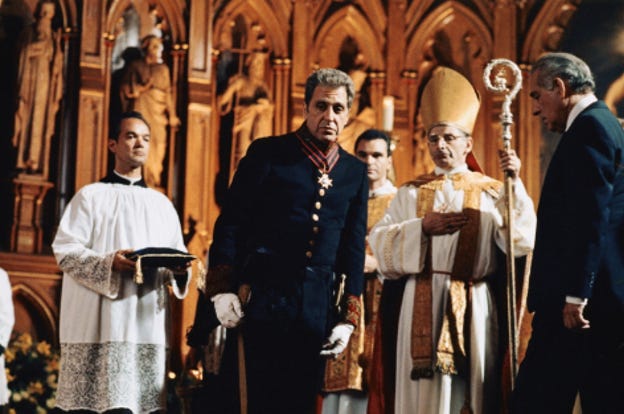
“Unlike American Catholics, who choose to believe that the pope and the church are above human frailty, Italian Catholics have no illusions about the Vatican. By June 21, 1963, when Conclave 81 announced Giovanni Montini’s election as Pope Paul VI, Italians knew that the Vatican had built a financial empire through the use of secret bank accounts and the advice of expert money men like Michele Sindona.
…
The Instituto per le Opere di Religione (IOR) is the head of the Vatican’s financial octopus. The IOR, known also as the Bank of the Vatican, looks like any other bank, except that the cashiers are priests…In addition to performing all the normal banking functions, the IOR also acts as the Vatican’s holding company. It owns major blocks of shares in eighty-two banks. Among them are the largest banks in Italy: Banca di Roma, Banco Ambrosiano of Milan, Banco di Napoli, and Banco di Sicilia. Its gold reserves are in excess of $3 billion [approx. worth $11.5 billion in today’s money].
With an estimated $11 billion [approx. worth $42 billion in today’s money] invested in stocks, the Vatican is the largest stockholder in the world.”
- Luigi DiFonzo, St. Peter’s banker (1983)
In Part II of this series, we left off with a man named Michele Sindona who would become the banker to both the Sicilian Mafia as well as the Vatican Bank.
Michele Sindona was born into a poor family living in a small commune in Sicily in the province of Messina. He had been educated by the Jesuits through the University of Messina (f. 1548 by Pope Paul III), the world’s first Jesuit college[1] and today among the oldest universities in Italy. Sindona was known as among the brightest students of his class. By the end of the war, Sindona had become a respected member of the Luciano/Don Calo crime family and one of the Sicilian Mafia’s leading financial advisors.
He had earned a degree in tax law from the University of Messina in 1942, but quickly entered the black market of Sicily as a leading figure after Operation Husky. Recall from Part I of this series that Operation Husky was the Allied invasion of Sicily, which in the name of supposedly fighting Italian Fascists, the Sicilian Mafia was given political power, by the CIA, over the island and had been given control of all major Italian ports which then facilitated the black market between the United States and Sicily. The CIA would also profit off this relationship in the trafficking of drugs and weapons in service to Gladio.
Sindona, appears to have been almost immediately recruited into this nexus upon his graduation, if not groomed for this task. One of his sources for protection, as he began his career as a leading figure in the black market of Sicily (in the lucrative Italian market of selling lemons) was through the bishop of Patti, who had close ties to Vito Genovese.[2] Sindona had known the bishop of Patti since he was as young as eight years old, and had visited him every Sunday where he had long conversations with the bishop after church service while accompanied by his grandmother Nunziata.[3] Thus, Sindona would receive his connection to the Mafia it appears through Vatican channels. The bishop of Patti used his influence with the Sicilian dons and US military officials to provide Sindona with fresh produce, forged papers, and safe passage throughout the country.[4]
Sindona would later establish himself in Messina, Sicily as a tax attorney. However, even bigger opportunities awaited him in Milan, the business district of Italy. When Sindona (along with his family, including his grandmother Nunziata) eventually left Messina for Milan, he had received the blessings of the bishop of Messina and an introduction that would lead him to Giovanni Montini (the future Pope Paul VI), then pro-secretary of state for the Vatican under Pope Pius XII.[5]
Between 1952 and 1955, Sindona spent a considerable amount of time in New York, acting as Luciano’s emissary to Vito Genovese[6] where he also met the Gambino family. By 1957, Sindona had become closely associated with the Gambino family and was chosen to manage their profits from heroin sales. By 1955, he had also become a CIA operative, providing a steady flow of black funds to leading Catholic dignitaries, including Giovanni Montini, who had worked as Undersecretary of State to the Vatican and had been promoted to Archbishop of Milan by then.[7] Montini would eventually become Pope Paul VI in 1963.
The Rise of Michele Sindona
It was upon their arrival in Milan, that Sindona’s grandmother Nunziata wrote to the bishop of Messina requesting he introduce Michel to important financial figures in the Vatican.
Luigi DiFonzo writes in “St. Peter’s banker”:[8]
“The bishop suggested that Michele speak with Monsignor Amleto Tondini, an official of the Curia, the central administration governing the financial affairs of the church. Ironically Monsignor Tondini turned out to be a distant relative; his sister was married to one of Sindona’s cousins. Tondini proved to be a valuable contact, for he was secretary of the briefs of princes and would later deliver the traditional address, ‘On Choosing a Pontiff’, to the members of the Conclave 81 two days before the cardinals were to select Montini as divine heir to the Fisherman’s throne.
Monsignor Tondini wrote a letter introducing Michele Sindona as a ‘man of trust’ to Vatican Prince Massimo Spada, a high-ranking member of the Vatican’s ‘black nobility’, an elite group of men who by birthright have access to the Vatican’s financial holdings.
…
Massimo Spada…proved to be the most important person during the lawyer’s [Sindona’s] early career in Milan. After meeting Michele, Spada immediately took the young man under his wing, introducing him to many important people, including Giovanni Montini.
…Massimo Spada…[was the one who] placed in motion the Vatican’s plan to purchase stock in important Italian businesses. The man Spada enlisted to help him fulfill the Vatican’s financial goals was Michele Sindona. It was the beginning of a relationship that in a few short years would lead Sindona into the world of international banking.”
From that point on, with Sindona’s introduction to Montini, who would be appointed archbishop of Milan in November 1954, he was at his service and was constantly doing him favors, whether it be with gaining Montini entry to celebrate mass in the factories and mills, to lending him money, $2 million for apparently a home for the elderly, which is difficult to believe was truly put to such a use since this money Sindona raised allegedly came from the CIA station in Milan. As the story goes, Sindona was able to raise all of the money in a single day. Evidently, the CIA was involved in giving millions a year to a great number of bishops and monsignors for activities promoted by the Catholic church, from orphanages to missions…[9]
In the year 1957 in Palermo, Sindona used mob money and CIA funds to create Fasco AG, a Liechtenstein holding company that became the cornerstone of his financial empire,[10] and invented the system of back-to-back financing, which included the transferring of money to Switzerland and Liechtenstein to avoid taxation. Through Fasco, he purchased his first bank – the Banca Privata Finanziaria (BPF) in Milan. ‘Founded in 1930 by a Fascist ideologist, the BPF served as a conduit for the illegal transfer of funds from Italy for a favored few.’[11]
The first minority shareholders to BPF, after Sindona’s purchase of the bank, were the IOR (Vatican Bank). The BPF served as a principal means of transferring drug money from the IOR for the purpose of Gladio.[12] William Harvey, the new CIA station chief in Rome, arranged for the financial firms of Sir Jocelyn Hambro, the owner of the Hambros bank, and David M. Kennedy, chairman of the Continental Illinois Bank of Chicago, to be added as minority shareholders, with each firm purchasing 22 percent of the bank’s stock. The bank operated through only two branches, in Milan and Rome.
Sir Charles Jocelyn Hambro was the son and heir of one of England’s most prestigious merchant banking families. At first appearance the partnership of Hambro and Sindona was a strange one, Sindona was not an established figure, did not come from an established family, nor was he a member of the international banking community. Indeed, his major asset, at the time of their meeting, was a newly created shell company. In other words, there was nothing that appeared lucrative or even secure in investing in Sindona’s enterprise.
However, the odd coupling of the two begins to make sense when looking further into Hambro’s history. Hambro was a British merchant banker, continuing the career of his father and his grandfather before him who founded the Hambros Bank in London 1839 and proposed setting up a state bank in India along the lines of the Bank of England.
It is likely not a coincidence that the year Hambros Bank was established was the year Britain would launch the Opium War against China over its right to trade in opium. Hambro would continue his family’s legacy as British merchant bankers, aka opium pushers, with his partnership with Sindona in laundering drug money.
Sir Charles Jocelyn Hambro was also a Special Operations Executive (SOE) intelligence officer and was the director of the Bank of England between 1932-1933 and was later tasked with setting up the bank’s exchange control division under the direction of Montagu C. Norman then director of Bank of England. In 1940, Hambro was made colonel and asked to join the Ministry of Economic Warfare, a cover organisation for the SOE. From 1940-1941, Hambro was in charge of overseeing the French, Belgian, German, and Dutch sections of the SOE and was its deputy leader for 5 months in the year of 1941. As chairman of the Hambros Bank, he extended its interests in commerce to the regions of Africa and Asia.
David M. Kennedy’s partnership with Sindona appears equally puzzling - at first glance. Raised on a ranch in Utah, Kennedy (no relation to JFK) was a devout Mormon whose grandparents (John Kennedy and Peter Johnson) formed the Bank of Randolph. In 1951, he became president of Continental Illinois after serving sixteen years as the debt manager for the Federal Reserve.
Paul L. Williams writes in “Operation Gladio”:[13]
“Based in Chicago, Continental Illinois was the seventh-largest bank in the country, with billions in assets, including shares in an Opus Dei bank in Barcelona. In 1955, Kennedy became a ‘conspicuous friend’ of the conservative Catholic religious order. This friendship resulted in Kennedy’s bank becoming the main channel for the Vatican’s real estate and corporate investments, an arrangement that brought him in close contact to Prince Massimo Spada, the lay delegato of the IOR, and Michele Sindona, Spada’s dutiful assistant. Through this connection, Kennedy emerged as one of Gladio’s key agents, and Continental Illinois came to serve as a major conduit for the flow of covert CIA funds into the newly created BPF [Banca Privata Finanziaria]. In this way, the Sindona bank served as the principal means of launching the 1967 coup d’état in Greece, a Gladio undertaking spearheaded by a group of right-wing army officers.”
Kennedy would serve as US Secretary of the Treasury (1969-1971), followed by the US Ambassador to NATO (1972-1973) during Nixon’s “War on Drugs.” In 1976, Kennedy founded the US-Taiwan Business Council and served as its Chairman for fourteen years. Only three years after its founding it played an important role in the drafting and passing of the Taiwan Relations Act (TRA) in 1979, the legislation that guides US-Taiwan relations in lieu of official diplomatic recognition. In other words, the TRA allowed for Taiwan to dictate its own trade relations with the US even if the PRC (People’s Republic of China) were to disagree. Thus, the government of mainland China would be powerless to dictate trade relations between Taiwan and the United States – a most favorable outcome if one wished to protect the narcotics and weapons trafficking network in East Asia that Taiwan had been implicated in since the days of Chiang Kai-shek (see Part I of this series).
Through Kennedy, Sindona developed a close friendship with Monsignor Paul Marcinkus, a cleric from Cicero, Illinois. Known as “the Gorilla”, Marcinkus stood six feet four inches. Marcinkus had worked closely with Kennedy in overseeing the Vatican’s American investments through Continental Illinois and became a director of the bank’s branch in Nassau, Bahamas.[14] Marcinkus would also become the president of the Vatican Bank and later a director of Ambrosiano Overseas based in Nassau, Bahamas as well.
Paul L. Williams writes in “Operation Gladio”:
“Sindona was instrumental in getting the Gorilla [Marcinkus] the position as head of the Vatican Bank. This position made Marcinkus a bishop, a prelate d’onore, and he was assigned as a special assistant to Cardinal Alberto di Jorio. The gruff cleric from Cicero [Marcinkus] was now responsible for more than ten thousand accounts belonging to religious orders and to private Catholic dignitaries, including the Pope. Sindona’s ties to the new bishop were tightened by the fact that Marcinkus, in defiance of Canon 2335 (the papal ban on Freemasonry), was a fellow Mason who had submitted to initiation on July 2, 1963. The Gorilla’s Masonic code name was ‘Marpa.’
Sindona next acquired the Banca di Messina, which gave the Gambino, Inzerillo, and Spatola crime clan unlimited access to a financial firm in Sicily. The Sicilian financier went to buy a third bank – the Banque de Financement (Finabank) – in Geneva, which was largely owned by the IOR and, like the BPF, used as a conduit to move money out of Italy. After Sindona’s purchase of majority interest, the Vatican retained a 29 percent share based on its awareness of the benefits of owning a Swiss bank for the transfer of laundered funds. Hambro and Kennedy, on behalf of their financial firms, gobbled up the remaining shares.”[15]
From these maneuverings, Sindona emerged as one of the most influential figures within international financial circles.
Williams continues:[16]
“ ‘Family Jewels,’ a set of CIA reports recently released under the Freedom of Information Act, shows that Sam Giancana, a Mafia capo from Chicago became one of the Agency’s underworld agents in the 1960s and one of the pivotal figures in the money-laundering process. Members of the Giancana family made deposits in Continental Illinois that were transferred to Sindona’s banks and enterprises in Liechtenstein and Milan. More money was transported by Giancana’s men to Washington, DC, where it was converted into bonds and forwarded to Finabank in Geneva. Still more money was transported from Chicago to Mexico in suitcases carried by thugs dressed as Catholic priests. The money was then sent to a string of shell companies in Panama before arriving at the Vatican Bank.
Throughout this process, the CIA, with the cooperation of Harry “Hank” Anslinger of the Federal Bureau of Narcotics (FBN), worked closely with Archbishop Marcinkus. According to Tullius “Tully” Acampora, a former CIA operative, ‘Hank was so close to Marcinkus that he could get Anslinger’s friends an audience with the Pope.’
Sindona’s banking enterprise flourished as billions of dollars from the narcotics trade flowed from Sicily to Switzerland. At the same time, he was learning one of the cardinal rules of theft: The best way to rob a bank is to buy it.
Much of the stolen money, however, did not end up in Sindona’s wallet or a safe within an Italian-American club in Brooklyn. Used to mount Gladio’s strategy of tension – and other covert ventures that would erupt in the coming decade – the $22 billion eventually lost [as is claimed at least] by Sindona and his compatriots in their banking ventures seemed to vanish into thin air. Financial analysts, to this date, remain mystified by the missing money.
Few have come to realize that the purpose of acquisition of banks by CIA operatives, including Paul Helliwell, Willam Colby, Donald Beazley, David Kennedy, and Sindona, was not to produce dividends for shareholders but rather to chalk up losses in a bewildering array of bogus ventures. Other bankers who shared Gladio’s vision of a New World Order created through the dissolution of political ideologies hostile American capitalism were willing to have their institutions undergo internal hemorrhages for the cause.
David Rockefeller, chairman of the Council on Foreign Relations, appears to fall into this category as suggested by the hundreds of millions of dollars in losses that came from Chase Manhattan’s investments in South America at the behest of the CIA. As Gladio emerged into an international operation, the billions from the drug trade proved insufficient to provide for the mounting expenses.
While Sindona was purchasing banks with funding from the Mafia, the Vatican, and the CIA, Paul E. Helliwell and Meyer Lansky were setting up Castle Bank & Trust in Miami and the Bahamas. Unlike Sindona’s banks, which were used to mount attacks in Italy, Turkey, and Western Europe, Castle Bank & Trust became ‘the conduit for millions of dollars earmarked by the CIA for the funding of clandestine operations directed at countries in Latin America and the Far East’.”
Williams continues”[17]
“The staff at the BPF [Banca Privata Finanziaria] was transferring large amounts of money from the accounts of depositors without their awareness. These sums were funneled into an account held by the Vatican Bank. The Vatican Bank, in turn, transferred the amounts, minus a 15 percent commission, to Sindona’s private account at Finabank in Geneva, which was named MANI for his two sons: MA stood for Marco, NI for Nino.
…
The Vatican Bank, in addition to owning 29 percent of the bank, maintained several accounts at the Banque de Financement…When the Swiss informed Sindona, the Vatican, Continental Illinois, and Hambros that they had forty-eight hours to close Liberfinco or they would declare Banque de Financement bankrupt, Sindona closed Liberfinco only to set up Aran Investment of Panama, another shell company, which displayed an instant deficit of $45 million.
…
In June 1967, Internal Revenue Service agents became aware that Sindona was involved in the drug trafficking of the Gambino-Inzerillo-Spatola clan. The case came to center not on heroin but ‘the illicit movement of depressant, stimulant and hallucinogenic drugs between Italy, the United States and possibly other European countries.’ [17a] But the investigation, thanks to the CIA’s intervention, came to a dead end.”
Mercator Senesis Romanam Curiam
1969 proved to be a banner year for Sindona. ‘He stood as the most powerful financial figure in Italy. The “Gruppo Sindona” included six banks, the international CIGA hotel chain, and five hundred other companies. He controlled the stock market in Milan, where 40 percent of the shares trade on any given day were under his control.’[18]
One late night in the spring of 1969, Sindona was summoned to the pope’s private study on the fourth floor of the Apostolic Palace, as per Luigi Fonzo in his book “St. Peter’s Banker.” Pope Paul VI (21 June 1963 to 6 August 1978) discusses his concern over the collapse of the “first republic” and the long reign of the Christian Democratic Party.
Luigi Di Fonzo writes in “St Peter’s banker”:[19]
“Because of his years of service as pro-secretary of state under Pope Pius XII, [Pope] Paul [VI] probably knew more about Vatican finances than any pontiff since Julius II[20]…Paul shocked the Vatican establishment by bringing his own advisers to Rome. The ‘black nobility’, as the establishment is called, had been dominated by Pius’s family, the Pacellis, and a few chosen friends, all of whom are given the title ‘Prince.’ Paul’s entourage – the press tagged them the ‘Milan Mafia’ – included Cardinal Vagnozzi, who had spent nine years in Washington as papal nuncio and had had the opportunity to study the financial genius of Cardinal Spellman (known in the Vatican as ‘Moneybags’).
Others were Cardinal Cody of Chicago; Cardinal Sergio Guerri, who was appointed governor of Vatican City; Cardinal Guiseppe Caprio, who was appointed president of the Beni della Santa Sede (Bank of the Holy Ghost); and Bishop Paul Marcinkus…who was appointed president of the Instituto per le Opere di Religione (IOR).
…
The most controversial person the Holy Father brought into his confidence, however, was Michele Sindona. Their relationship would transform the Vatican from a powerful Italian corporation into a multinational financial power. Before that could happen, however, the Vatican had to resolve its tax problem.
In 1962 the center-left coalition government of Premier Amintore Fanfani passed a dividend tax (cedolare) on profits earned on the Italian stock market. Through April 1963 the Vatican paid taxes. Then Fanfani’s government was defeated. Giovanni Leone formed an all-Christian Democrat caretaker government. Leone granted the Vatican a tax exemption. [author’s note: Thus, from the very beginning of Pope Paul VI’s papacy, which began on 21 June 1963, he enjoyed a tax-exempt status for the Vatican Bank.] Minister of Finance Mario Martinelli, a Christian Democrat, signed the exemption and sent it to the tax agency. When the caretaker government was replaced by Aldo Moro’s center-left collation government, Pietro Nenni, a socialist and the minister of the treasury, supported finance minister Roberto Tremelloni’s rejection of the Vatican’s exemption. In search of a compromise, the government asked the Vatican for a complete list of its share. The Vatican refused to provide the information.
Pope Paul turned to Michele Sindona…Working behind the Vatican front men, Sindona successfully convinced the tax officials to file the Vatican tax exemption until a more favorable government was formed. In the meantime the Vatican continued to earn millions on the Italian stock market without paying either the 5 percent or the 30 percent tax.”
Luigi DiFonzo continues:[21]
“In mid-1964 Moro’s government fell and was replaced by another Moro government. This time, however, the new minister of the treasury, Socialist Giovanni Pieraccini, refused to allow the Vatican tax issue to lie dormant. The fight now threatened more than the Vatican finances. Sindona realized that the left was too powerful and would support the plan for continued nationalization. The left was, therefore, a threat to his growing empire, now valued at about $100 million [approx.. $382 million in today’s money].
Michele Sindona made a brilliant and powerful move against the left. In 1964 the Italian stock market was depressed. Sindona decided that the government could not survive if he attacked the economy. Acting on Sindona’s advice, the Vatican threatened to sell hundreds of millions of dollars’ worth of stocks on the open market. The threat was timed perfectly to coincide with the resignation of the president of the republic, Antonio Segni. The plan worked. A bill ratifying the Vatican’s exemption was passed and signed by Moro, Tremelloni, and the new president, Guiseppe Saragat, a Social Democrat. Pieraccini, however, refused to endorse the bill. Without his signature, it was sent to parliament for approval. For some reason the bill never passed the legislative committee. In 1967 the issue was revived with a series of articles in the Italian left-wing press that called the Vatican ‘the biggest tax evader in postwar Italy.’ According to one source, the Vatican owed as much as $720 million in unpaid taxes [approx. $2.8 billion in today’s money].”
This was the reason for Sindona’s summoning to the pope’s private study in the late evening during the spring of 1969. Such a private summoning by a pope was extremely rare in Vatican history.
According to Luigi DiFonzo, Pope Paul VI spoke of a “terrible problem” referring to the parliamentary ruling on the Vatican investment tax. If Italy were successful in taxing the Vatican on its investments, it would open the doors for other countries to do the same, which would hemorrhage the Vatican’s financial power that had grown worldwide. ‘It was not Michele’s fault, the pontiff assured him. He had taken on a difficult task and had done a marvelous job of stalling the inevitable.’[22]
Pope Paul VI’s pontificate was already under serious challenge by the traditionalists, and the conservatives were less than supportive. Most of the infighting was over Pope Paul VI’s chosen course throughout the session of the Vatican II councils, who was the acting president over the council after Pope John XXIII.
DiFonzo writes:
“Michele proposed a strategy to move Vatican resources out of Italy and into the profitable, tax-free Eurodollar market by way of a network of offshore tax corporations. The move would not only give the Vatican added secrecy – which the Vatican cherished as much as the Mafia treasured omerta – but would also demonstrate to other countries that the Vatican was strong. In the long run, Sindona said, they would see that Italy was the one that suffered.
…
Pope Paul handed Michele Sindona the agreement he had already prepared. Sindona read it quickly, it was more than he had hoped for, more than he would have dared to suggest. The Holy Father, by virtue of that document, had granted him complete control of the Vatican’s foreign investment policy..”
Sindona would now carry the Vatican title Mercator Senesis Romanam Curiam, ‘the leading banker of the Roman Curia,’ and granted him complete control over the Vatican’s foreign and domestic investment policy. In accordance with the agreement, Sindona would work closely with Bishop Marcinkus, who now became secretary of the IOR (Vatican Bank), and Cardinal Sergio Guerri, governor of Vatican City. However, both clerics remained merely his advisors. The agreement placed the Vatican’s billions at Sindona’s disposal.
At first glance this seems like a remarkably risky move by Pope Paul VI and paints the pope’s position as greatly weakened in his seat of power. Why else would the pope agree to align himself so closely with a man who made a name for himself as banker to the Sicilian Mafia? However, looks are often deceiving. Recall that Sindona was trained since he was a youth by the Jesuits, and that his rise to fame as a tax lawyer for the Sicilian Mafia was in fact first arranged by the bishop of Patti. Sindona had received his high-level connections with the Mafia and their trust in fact through Vatican channels. Thus, Sindona appears to be more the Vatican’s man than that of the Mafia, and whom better to manage both the affairs of the Sicilian Mafia and the Vatican Bank, than a Jesuit trained banker who as a youth of eight years old wished nothing more than to service the Church?[23]
Before Sindona took control of the Vatican Bank’s assets, ‘the Vatican held major interests in the Rothschild Bank in France, the Chase Manhattan Bank with its fifty-seven branches in forty-four countries, the Credit Suisse in Zurich and also in London, the Morgan Bank, the Bankers Trust, General Motors, General Electric, Shell Oil, Gulf Oil, and Bethlehem Steel. Vatican officials sat on the board of Finsider, which, with its capital of 195 million lire spread through twenty-four companies, produced 90 percent of Italian steel. The Holy See controlled two shipping lines and the Alfa Romeo car manufacturing company. What’s more, controlling share of the Italian luxury hotels, including the Rome Hilton, were in the Vatican portfolio.’[24]
But the Vatican’s central holding was Societa Generale Immobiliare (SGI), the largest real-estate and construction company in Italy and was among the largest land owners and the most important building promoter in the city of Rome. [24a] It operated in Italy, particularly in Rome, and in the rest of the world as a construction company of entire neighborhoods, but was also active in industrial construction. It had produced a fortune in earnings for the Holy See since it had been acquired in 1934. ‘In 1969 Immobiliare shares were selling for 350 lire. Sindona purchased 143 million shares from the Vatican at double the market price – 700 lire per share – with money that had been illegally converted to his account from deposits at Banca Privata Finanziaria. Sindona was willing to pay double the market value.’[25] The money, after all, would be spent, in part, to bring about significant changes in the political order, i.e. in service to the Gladio Crusade.
In Rome, June 24, 1970, Societa Generale Immobiliare (SGI) had announced that Gulf and Western (G&W) Industries had acquired 15 million shares, representing 10.5 percent of its common stock. [25a] SGI also included in their announcement that “Societa Generale Immobiliare would become associated with G&W in the American conglomerate’s Paramount Pictures venture” as reported in The New York Times. [25a] Gulf and Western, an American conglomerate, had originally focused on manufacturing and resource extraction, but began purchasing a number of entertainment companies beginning in 1966 into the 1970s. Among these were Paramount Pictures in 1966.
Interestingly, Paramount Pictures would film the The Godfather trilogy, the first installment released in 1972, two years after SGI began its joint venture with G&W. This is especially interesting concerning the storyline of The Godfather III which would portray a warped version of reality. In the movie, the Vatican Bank has accumulated a massive deficit of $765 million and Michael Corleone offers $600 million in exchange for 25% share in Internazionale Immobiliare, a fictional international real-estate company, a clear reference to SGI. This would make Michael the largest single shareholder with controlling interest. The offer is approved pending on the ratification by Pope Paul VI. This is done, rather ironically, because Michael would now like to be a “legitimate” businessman, it is clear, that he still has a lot to learn about how the world works.
Later, Michael realises that the Immobiliare deal is an elaborate swindle arranged by certain members within the Vatican that control the affairs of the Vatican Bank. Following Pope Paul VI’s death, Cardinal Lamberto (a fictional name) is named Pope John Paul I (the actual name of the 33-day pope who follows after Pope Paul VI). Pope John Paul I is depicted in the movie as a good man, “a real priest” in the words of Michael Corleone after his confession to Lamberto. The movie has shown that there is clear corruption in the Vatican, especially pertaining to the Vatican Bank and Immobiliare and it appears the new pope will be making a great deal of changes.
But this hopeful reform and moral restoration of the Vatican is bludgeoned in its cradle by the hand of Archbishop Gilday, who kills the new pope with poisoned tea before his papacy had a chance to begin. The Corleone mafia family are ultimately portrayed as folk heroes triumphantly fighting the brutal oppression that the Sicilian people have been subjected to for centuries, and they exact their revenge perfectly, even gunning down Archbishop Gilday in full religious garb within the walls of the Vatican.
The reader should be aware that the Sicilians were treated as dogs and subhuman by many Italians on the mainland, especially in the more distinguished city centers such as Milan. One very large reason for this is due to the fact that Sicily was for centuries the Emirate of Sicily and was part of the Islamic Golden Age which began in 622 CE and lasted till 1258.
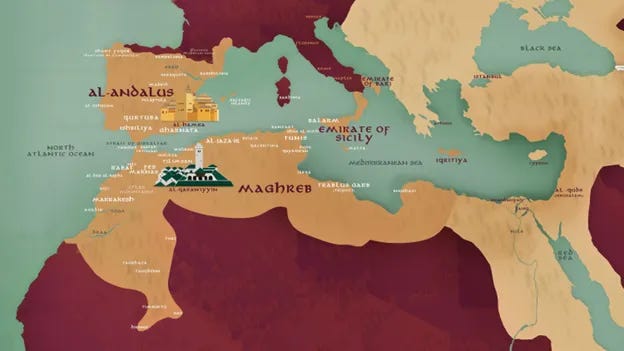
The Muslim rule over Sicily only ended with the Norman invasion, it appears at the bidding of the Papal States, which was fought from 1060-1091. Many historians regard this as the first Crusade. Thus, the Sicilian culture, which has been inextricably influenced by Islam over several centuries, has always been an eyesore to the Vatican and there is most certainly a disdain for the island amongst its more die-hard Crusader ideologues to this day.
The Godfather trilogy is a Hollywood classic to say the least, many think it a work of art that depicts the Italian mafia in all of its splendid monstrosity, tragedy, honor and glory. However, the reality is that the Godfather franchise was fabricated in order to cover up the ugly truth about the Italian mafia, most notably their partnership with international criminal rings tied to the Vatican and Gladio terrorist networks through largely drug profits, that was beginning to spill over into the newspapers. In other words, it was damage control. Contrary to how the movie would have us believe, the mafia brotherhoods had always been the servants to the Vatican and have been from their very origin back in the late 15th century in service to the Spanish Inquisition.

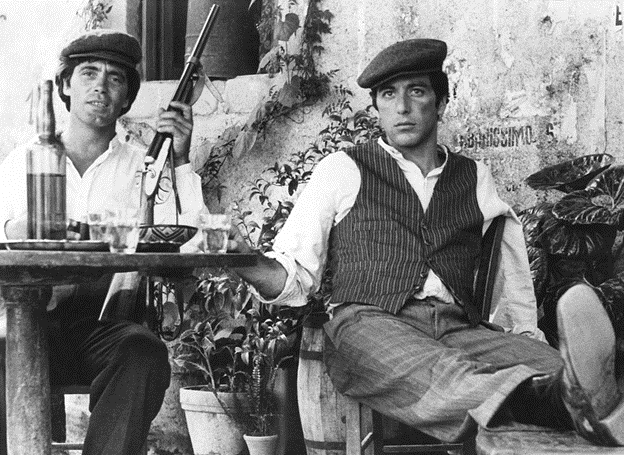
This is the true tragedy of the story of the Sicilian people. That the fable was spread to the oppressed Sicilian people, since the first Crusade, that the only exit out of such a life of poverty and oppressive rule was to join the heroic bandits, the Sicilian mafia. However, what this really meant was that they would continue to be regarded as dogs but at least they were now dogs in service to the Church, one could argue – in service to their very oppressor.
The Sicilian mafia would get its hands dirty in service to the Papal States, and they were told they would die with “honor” with a warrior code similar to that of the Crusader knights who served the Church. Sindona, a Sicilian was no different. His life had been chartered for him as a bright youth from the very beginning, and he like so many others were told there was no other choice but to go into the service of the Church.[26]
As always, there are apologists out there who try to make the claim, rather absurdly, that the Vatican had no choice but to have interaction with the Sicilian mafia, since the latter controlled everything that occurred in Italy. Again, if one looks at the origin of the Mafia brotherhoods, it is clear who is holding the leash in this relationship.
Luigi Di Fonzo writes in “St. Peter’s banker”:[27]
“In a number of incidents…members of the clergy have crossed the line of friendly coexistence with the Mafia. In 1962, for example, four Franciscan monks were tried, convicted, and sentenced to thirteen years’ imprisonment for conspiracy, extortion, and manslaughter. In 1975 Father Agostino Coppola was arrested for being a high-ranking member of the Mafia (in Sicily it is not unusual for the local Mafia boss to be a priest) and a member of Anonim Sequestri, a quasi-neofascist group headed by the ruthless mafioso Luciano Leggio. Father Coppola was accused of masterminding one murder and the kidnappings of three prominent Italians. At his trial it was also revealed that Coppola had laundered the Mafia’s ‘black money’ through banks and produced votes for Sicilian ‘High Mafia’ politicians. And in 1978 a Franciscan monk, Fernando Taddei, prior of St. Angelo Church in Rome, was arrested for buying ransom money – at 70 percent of face value – from the Mafia and washing it through Vatican-owned banks.”
All of the mafia drug profits, from cocaine to heroin, were made possible by the backing of the CIA and the Vatican channels. And they continue to be in service to the permanent warfare mission that was launched by members of the Vatican, aka the Crusades, just now it is under a different name – Gladio which means “sword.”

Sindona had purchased SGI from the Vatican, which had a joint venture with Paramount Studios in Hollywood by 1970, and was where the Godfather trilogy was shot. Charlie Bluhdorn had not only become the CEO, chairman and president of Paramount Pictures after his 1966 acquisition of the entertainment company and had become president of Gulf and Western after his purchase of the industry in 1956, but had become a member of the 13-man board of directors of SGI in 1970. [27a] ‘Through arrangements with Bluhdorn, profits from the Coppola epic flowed into Sindona’s banks and holding companies, along with billions from the heroin trade. Life was imitating art.’[28]
Thus, the profits made off of The Godfather trilogy went to Sindona’s banks and holding companies in service to Gladio. They basically did a movie about their crimes (however, left out who was truly behind the murder of Pope John Paul I and that there were no heroes within the Sicilian Mafia that stood against this) sold it to the public, made hundreds of millions, all to further service their far-right Crusader cause and somehow the Sicilian Mafia looks “honorable” at the end of all of this…
It might appear at first as confusing, why would what was essentially a Vatican company, SGI, which had a joint venture with the Hollywood studio make a movie that admitted that Pope John Paul I was indeed murdered due to him being “a real priest” and his intention to reform the Vatican Bank?
Keep in mind, that this movie franchise was not only made for an American audience but was especially powerful with the Italian audience who already held a healthy distrust of the Vatican. The Godfather trilogy was meant to reinforce the heroic folk story of the mafia as honorable bandits who were ultimately defending the Sicilian people. From Vito Corleone to Michael, we see a legacy that ultimately cares about the Sicilian hardship and wishes only to have the power to keep those they care about safe. And though this is most definitely a genuine desire, especially for those who first join, it must be understood, in the end it is no different than making a pact with the Devil.
The Sicilian people, and Italians more generally, are very aware of the level of corruption and malice that has governed positions of power and influence in Italy, however, the solutions out of such a purgatory have been muddied, see my series “The French Connection: The Knights of Malta, the Scottish Rite & the Rise of the Mafia Brotherhoods.” The Godfather trilogy is a romantic fabrication, a lie that the Italian people have been told repeatedly. Those who have lived under the oppressive rule of the mafia unleashed in its full form know that such periods have only been filled with further terror.

Along with his acquisition of SGI, Sindona was also able to purchase the Vatican’s majority ownership of Condotte d’Acqua, Italy’s water company, and Ceramica Pozzi, a chemical and porcelain company. He also bought Serono, the Vatican’s pharmaceutical company. Yes, the Vatican owned their very own pharmaceutical company…Among, no doubt, numerous drugs with suspect purposes was Luteolo, a contraceptive that was marketed euphemistically as a medication “for regulating female malfunctions.”[29] Thus, it appears it was prescribed to women without their knowledge that they were in fact taking a contraceptive. When the Vatican’s ownership of Serono was revealed, they quickly sold the company to Sindona. Thus, only really a transference in name, the Vatican would clearly continue to profit and influence the management of Serono. Serono has since merged with Merck (in 2006) and is now Merck Serono.
Paul L. Williams writes in “Operation Gladio”:
“Despite Sindona’s diversionary tactics, the press got word of the sales of the Vatican companies and pressured the Holy See for a response. Through a spokesman, Pope Paul VI said: ‘Our policy is to avoid maintaining control of our companies as in the past. We want to improve investment performance, balanced, of course, against what must be a fundamentally conservative investment philosophy. It wouldn’t do for the Church to lose its principal in speculation.’
…Sindona proceeded to liquidate the Church’s remaining holdings in Italian companies to buyers, including Hambros Bank, Continental Illinois, and the American conglomerate Gulf and Western [author’snote: recall CEO of Paramount Bluhdorn owned Gulf and Western]. He [Sindona] invested much of the Vatican’s revenue from these sales in American companies, such as Chase Manhattan, Standard Oil, Westinghouse, Colgate, Proctor and Gamble, and Dan River. Several of these firms remained under the control of David Rockefeller.
The liquidation of the Vatican’s holdings, as engineered by Sindona, produced a disastrous effect on the Italian economy. The shares of the Italian companies in which the Holy See had invested plummeted to record low levels. The lira dropped precipitously in value. Unemployment rose. The cost of living increased. The savings of millions of families were wiped out almost overnight.”